

These Disneyland photos from the 60s follow a park that never stopped changing. The Monorail and Matterhorn Bobsleds opened in June 1959, It’s a small world and New Orleans Square followed in 1966, a rebuilt Tomorrowland and Pirates of the Caribbean arrived in 1967, and the Haunted Mansion opened in 1969.
Updated October 24, 2026.
Anyone who has studied old theme-park pictures learns to date them by small things: the signs over the ticket booths, the cut of a costume, which ride is under construction in the background. Disneyland in the 1960s rewards that habit. It’s the same game you play with old family albums, guessing the year from the haircuts and the cars.
It didn’t take long for Disneyland to become more popular than most attractions ever get. By the 60s, the mouse was flexing its muscle. Disneyland was no longer just a local favorite and was starting to draw visitors from around the world, thanks in large part to Walt Disney and his constant tinkering with the park.
The 1960s were a decade of change and growth for Disneyland, as these Disneyland photos from the 60s show. Many attractions were closed or reinvented during the decade. Midget Autopia, a version of the original Autopia ride for younger children, closed in 1966 to make way for It’s a small world. The main Autopia, meanwhile, got a center guide rail in 1965 so younger kids could ride the cars.
More rides closed too, such as the Conestoga Wagons, Mineral Hall, Monsanto Hall of Chemistry, Space Station X-1, Rocket to the Moon and many more. But new attractions and lands were added. The Swiss Family Robinson Treehouse was added in 1962 and the Enchanted Tiki Room in 1963. But in 1966, one of the biggest moments for the park came when New Orleans Square opened where Holidayland used to be.
That was the last land at Disneyland built under Walt Disney, who died that December. While the world mourned, Roy Disney, Walt’s older brother, took over running the company. That doesn’t mean Walt’s influence faded. In 1967, Pirates of the Caribbean opened in New Orleans Square and was an instant hit.
The decade ended with another blockbuster debut, the Haunted Mansion, as you’ll see in these Disneyland photos from the 60s.
Disneyland photos from the front gate

Disneyland held its press preview on July 17, 1955, with about 28,000 people, and opened to the public the next day. The one millionth guest, Elsa Marquez, came through the gate on September 8, 1955, according to D23, Disney’s official fan site. By the 1960s the park was counting guests in tens of millions: the 25 millionth arrived on April 19, 1961, and the 50 millionth on August 12, 1965.
General admission to Disneyland in the 60s cost a mere $1.60 for adults in 1964 and $2.00 by 1966. In 1966, juniors paid $1.20 and children under twelve just sixty cents. However, this only got you into the free shows, exhibits and entertainment, plus the free lands and Main Street. That meant no rides. Anyone who has bought a theme park ticket lately would read those prices twice.

Paying for the park changed early. Before ticket books, a single gate admission cost $1.00 including tax. On October 11, 1955, Disneyland introduced ticket books with park admission plus eight attraction coupons, priced at $2.50 for adults, $2.00 for juniors and $1.50 for children. The first books held A, B and C coupons. D coupons followed in June 1956, and E coupons arrived on June 12, 1959, for the Matterhorn Bobsleds, the Monorail and the Submarine Voyage. That is where the phrase E ticket comes from.
In the 1960s and throughout the 1970s, Disneyland sold ticket books, and which book you bought decided what you could ride. In 1966 an adult “Big 10” book sold for $4.00 and held one general admission ticket plus ten coupons: one A, one B, two C, three D and three E.
In 1974 an adult “Big 10” Ticket Book sold for $4.75 per person, which included admission to the park and access to 10 attractions. A “Big 13” Book cost just a dollar more at $5.75, and it got you into the park plus 13 attractions. Each of these books only allowed a set number of rides in each category.
Disneyland also had a special 12-Ride Book that was only available to Magic Kingdom Club members. In the summer of 1972 it sold for $4.75 for adults.

The price of parking from 1955 to around 1970 was just 25 cents. Adjusted for inflation, that equals about $2.35 in 2018. It was just 50 cents in the 1970s and $2.00 in the 1980s until the rapid price increases began.

Originally, the parking lot was built to hold about 12,175 cars. It eventually grew to 15,167 spaces. The well-known character sections were added as easy parking reminders sometime in the mid-1980s. Before that, the lot was divided only by letters. Anyone who has wandered a huge parking lot trying to remember where the car is knows why a simple idea like that matters. It only added to the magic of Disney and its lasting imagination.
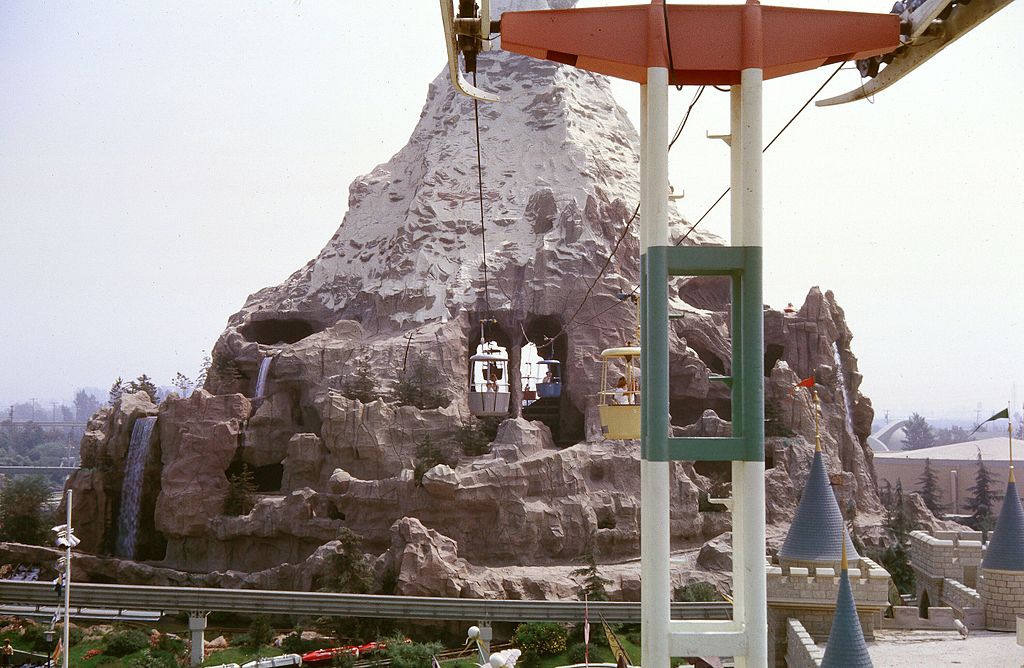
The Monorail ran over the entrance area. It opened on June 14, 1959, as the first daily operating monorail in the Western Hemisphere, and the same day the Matterhorn Bobsleds opened as the world’s first tubular steel roller coaster. The track reached the Disneyland Hotel in 1961.

The original parking lot closed permanently on January 21, 1998, to make way for Disney’s California Adventure. It had served park guests for the first 42 years of Disneyland’s existence.
Disneyland photos of Main Street USA

Visitors to Disneyland have made it a habit to take a picture in front of the famous Floral Mickey, as these boys posing at the Mickey flower arrangement in 1965 show. Disney’s horticulture fact sheet counts roughly 4,300 annuals (flowers that last one season) in Mickey’s face and another 1,600 on the sides.
Disney’s horticulture team replaces the flowers about nine times a year with blossoms that fit the season. During colder seasons, violas are often used while the warmer seasons call for alyssum. They even go a step further and color code the flowers for holidays. Today during special events such as Mickey’s Not So Scary Halloween, guests may see Mickey wearing black, orange and white. And Christmastime, of course, calls for red, greens, and poinsettias.
Not only have the colors of Floral Mickey changed, but so has the design. Earlier versions such as this one from 1965 show a full, round-faced Mickey. Later versions gave Mickey a more cartoon-like look. Some days there are more flowers than others, but one thing that will never change is the location of this arrangement. The giant smiling face of Mickey has been there since guests first entered the park on opening day in July 1955 and can still be seen at Disneyland today.
Fantasyland and It’s a small world

Fantasyland was part of the original park, and this 1961 view predates its biggest 1960s addition. It has a Renaissance feel, with Sleeping Beauty’s Castle out front and King Arthur’s Carrousel standing out in the courtyard. Originally it had a theater called the Mickey Mouse Club Theater, which was renamed the Fantasyland Theater in 1964. The theater put on several shows including It’s Tough to Be a Bird (1969) and Winnie the Pooh and the Blustery Day (1969). Today the theater’s site is home to Pinocchio’s Daring Journey.
Disneyland’s 1961 look came back to life in 2012 when a scene for Saving Mr. Banks was filmed at the park. The film, with Tom Hanks as Walt Disney, tells the story of Walt’s quest to bring Mary Poppins from the pages of P.L. Travers’ novel to the big screen. Fantasyland was redecorated as the 1961 version of the park. More than 400 cast members took part in the three-minute scene, and signs that looked like the ones from the 1960s were hung above the turnstiles. The Mickey Mouse flower garden was changed to give it a 1961 retro look, and Imagineers made copies of ride posters in the exact colors to hang along the fence.
It’s a small world debuted at the 1964 New York World’s Fair, then opened at Disneyland on May 28, 1966. Mary Blair is credited with the ride’s design and color styling, and Robert and Richard Sherman wrote the title song. The Disneyland version was originally sponsored by Bank of America. The ride, which celebrates different cultures from around the world, became a huge hit for Disneyland.
Former attractions in Fantasyland:
- The Chicken of the Sea Pirate Ship and Restaurant (1955-1982)
- Fantasyland Autopia (1959-1999)
- Fantasy Fair
- Keller’s Jungle Killers (1956)
- Fantasyland Depot (1955-1993)
- Mickey Mouse Club Circus (1955-1956)
- Mickey Mouse Club Theater (1955-1964), later the Fantasyland Theater (1964-1982)
- Midget Autopia (1957-1966)
- Motor Boat Cruise (1957-1991)
- Skull Rock (1961-1982)
- Skyway to Tomorrowland (1956-1994)
Disneyland photos of Tomorrowland


The Monsanto House of the Future opened on June 12, 1957 and closed in December 1967. Monsanto sponsored it with MIT and WED Enterprises, and it was built from glass-reinforced plastic. More than 20 million people walked through it. Demolition proved so hard that crews finally used choker chains to crush it.
The PeopleMover came to Disneyland on July 2, 1967, using a WEDway system adapted from the Ford Magic Skyway at the 1964-65 World’s Fair. It was built in Tomorrowland because the ride fit the area’s futuristic feel. Small trains on raised tracks carried people on a big circular tour above Tomorrowland.
The trains were originally painted red, blue, yellow, or green with white roofs. In 1987-88 this look changed when the trains were repainted white with colored stripes. Each train was fitted with safety rails in 1968. These rails only partly wrapped around the cars until 1985, when they were changed to wrap all the way around the cars for the passengers’ safety. The reason for these additions was the accidents that happened aboard the PeopleMover.

In August of 1967, a 16-year-old boy was killed while jumping between two moving PeopleMover cars inside a tunnel. He stumbled, fell onto the track and was struck by an oncoming train. The ride had only been open for a month at the time. Another incident happened in 1972, when a girl lost her mouse-ears cap and she and her cousin jumped onto the track to get it back. The cousin ran through a tunnel and out an exit, where she fell about thirty feet to the concrete below, breaking an arm, a hip and her pelvis.

The ride eventually closed on August 21, 1995, because Imagineers thought the technology had passed its time, and Rocket Rods took over its track in 1998. However, there is a PeopleMover still running at Walt Disney World in Orlando, Florida. The Magic Kingdom’s version opened July 1, 1975.

This picture, taken just a year before “New Tomorrowland” arrived, gives a closer look at the outfits Disney guessed we would wear by the 1980s. By this time, Disney had added a lot of attractions at Disneyland, including the Monorail, the Submarine Voyage and the Matterhorn (now part of Fantasyland). They were so big that people called it the second grand opening of Disneyland.

It would be fun to see Disneyland Cast Members dressed this way today, and the love for these vintage outfits hasn’t gone away. People who really love Disney culture and history have worn these old Cast Member outfits as Halloween costumes. Some have even been seen wearing them to special Disneyland events such as Mickey’s Not So Scary!

But around this time in 1966, Disney execs quickly saw how out of date Tomorrowland was getting. Tomorrowland was rebuilt in 1967, and the new land added the Carousel of Progress, Adventure Thru Inner Space, Circle-Vision 360 with a new version of “America the Beautiful” across nine screens, Flight to the Moon, the PeopleMover and the Rocket Jets. This section of Disneyland gets more updates and upgrades than any other area of the park. These changes give Tomorrowland’s tagline “World on the Move” its meaning.

Disneyland photos of New Orleans Square

Walt Disney first started making plans for New Orleans Square in the late 1950s, and it was even on a souvenir map in 1958. It was the first land added to Disneyland after the park’s opening and took the place of Holidayland.
Walt did see his vision of New Orleans Square come to life when it opened to the public on July 24, 1966, and he led the opening ceremony. The land cost $18 million, covers about three acres and is themed on 19th-century New Orleans. Mayor Victor Schiro named Walt Disney an honorary citizen of the city at the ceremony, and Disney joked that the land cost as much as the Louisiana Purchase. It was his last major public appearance at Disneyland. He died on December 15, 1966, at age 65.

He was involved in the production of Pirates of the Caribbean, the last ride he helped design, which opened on March 18, 1967, three months after his death. The Blue Bayou Restaurant opened beside it the same day.

The Pirates of the Caribbean was the anchor ride at New Orleans Square until the Haunted Mansion opened in August 1969. Disneyland set an attendance record of 82,516 guests on August 16, 1969, shortly after it opened.
The Mickey Mouse balloons

As you can see from this photo, the Mickey Mouse balloon has been a much-wanted Disneyland souvenir for decades. People could buy these balloons even before the park opened, as Mickey-eared party decorations made since the 1940s. The helium version became a park fixture in 1956, and it was at Disneyland that this souvenir became famous and in demand. If you’ve ever walked past a balloon cart with a small kid, you know how hard it is to keep walking.
Treb Heining, a former Disneyland employee, started his unusual career as a Balloon Boy in 1969, at age 15, selling balloons to guests. He became well known for his ability to tie more than 1,000 of these Mickey balloons in just an hour! He got so hooked on it, and so good at it, that he started his own company, BalloonArt by Treb, in 1979. He started by selling balloons to parties, but eventually handled big events such as the Super Bowl and the 1984 Olympic Games.
Heining went back to his roots in December 1985, when he and Tom Holowach put together Skyfest for the park’s 30th anniversary, a million-balloon launch that set a Guinness World Record for the most balloons released at once. In the 1990s Disney Parks had him design the Glasshouse Balloon, a clear balloon holding a smaller Mickey-shaped one. He also created a Mickey balloon that lights up, and he is now head of Glasshouse Balloon Company, Inc., in a balloon industry that employs more than 50,000 people worldwide. Can you believe his career all started with a mouse?
Disneyland photos from the 60s: common questions
When did New Orleans Square open?
New Orleans Square opened on July 24, 1966, at a cost of $18 million. It covers about three acres and is themed on 19th-century New Orleans. Walt Disney attended the opening and was named an honorary citizen of New Orleans by Mayor Victor Schiro. It was his last major public appearance at Disneyland. Pirates of the Caribbean followed on March 18, 1967.
When did the Haunted Mansion open?
The Haunted Mansion opened at Disneyland in August 1969. The park set an attendance record of 82,516 guests on August 16, 1969, shortly after the opening. The ride sits in New Orleans Square, which opened in 1966. Walt Disney died on December 15, 1966, so he did not see it open.
What was the PeopleMover at Disneyland?
The PeopleMover was an elevated ride through Tomorrowland, run on the WEDway system that Disney adapted from the Ford Magic Skyway at the 1964-65 New York World’s Fair. It opened on July 2, 1967 and closed on August 21, 1995. A version at the Magic Kingdom in Florida opened on July 1, 1975 and still operates.
How many people had visited Disneyland by 1965?
Disneyland recorded its 25 millionth guest on April 19, 1961 and its 50 millionth on August 12, 1965, according to D23. The one millionth guest came much earlier, on September 8, 1955, about seven weeks after the opening. The 100 millionth followed on June 17, 1971.