

These vintage Coney Island photos show the beach, Surf Avenue, Steeplechase Park and Dreamland in the early 1900s. Below them is the story of the landmarks that carried Coney Island through its mid-century heyday: the Wonder Wheel in 1920, the boardwalk in 1923, the Cyclone in 1927 and the Parachute Jump in 1941.
Updated November 3, 2026.
Coney Island was where New Yorkers went when the city got too hot. The pictures here run from 1901 to 1910. The rides people still talk about came a little later, and their history follows the photos.
I’ve driven to a lot of old roadside attractions over the years, and the ones that last almost always have one thing people can see from the highway. Coney Island had several. I also love vintage photos, because a good one shows how a place was built to be seen.
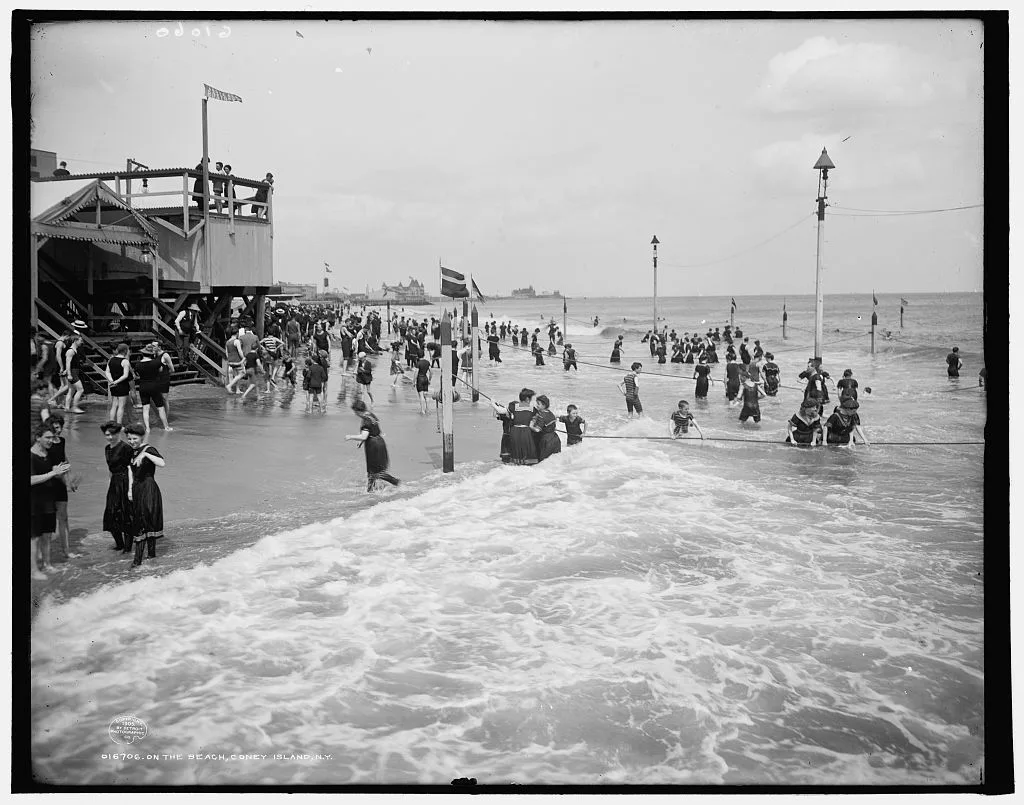
Most of us have squeezed onto a crowded beach on a hot day. The photo below, from around 1905, shows that same idea more than a century ago.
How Coney Island Became America’s Playground
NYC Parks says that once the BMT subway line reached the area in 1920, the pleasures of Coney Island were “just a five-cent ride away from the steaming city.” The trip to the beach now cost a nickel.
The crowds followed. NYC Parks says attendance on a hot summer day could reach as high as a million people, and the beach became extremely congested. Food got cheap too. Nathan’s Famous began in 1916 as a nickel hot dog stand run by Nathan Handwerker and his wife Ida. It undercut Feltman’s, which charged 10 cents, and the original stand still sits at Surf and Stillwell avenues.
Most of us have watched a food stand cut its price to win the lunch crowd. Nathan’s did it with a nickel, and the stand is still there. Cheap was the whole idea.
Surf Avenue and the Bowery in Vintage Coney Island Photos
The next two pictures were taken only a couple of years apart. One shows Surf Avenue in 1901, the street where Nathan’s stand would open fifteen years later. The other shows the Bowery, an amusement street, around 1903.
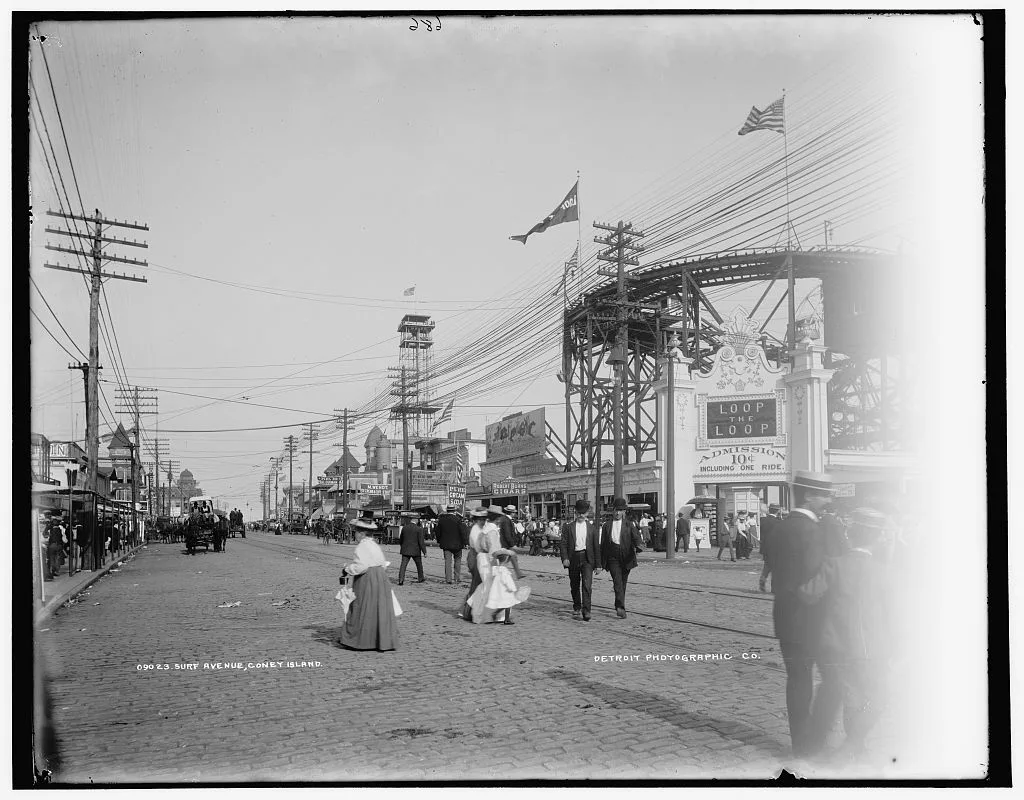
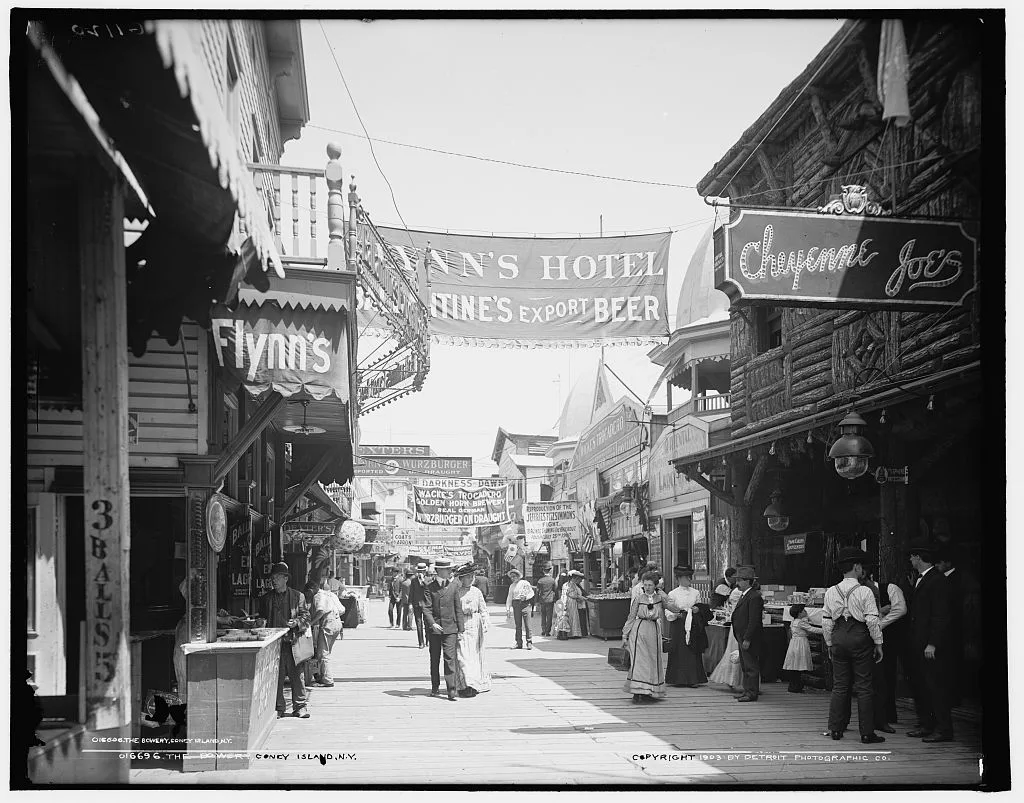
The same idea, a street built to be looked at, shows up in our vintage Times Square photos. Both places grew up around crowds that came to be entertained. Even in 1901, the street itself was an attraction.
Steeplechase Park History
George C. Tilyou opened Steeplechase Park in 1897. NYC Parks marks that year as the start of Coney Island’s era as “the Nation’s Playground.” Tilyou enclosed his rides behind a gate and charged 25 cents for 25 attractions. He called the place Steeplechase, “The Funny Place.”
A gate with rides inside is how most of us picture a park today. Tilyou had one running at Coney Island almost 60 years before Disneyland in the 1950s.
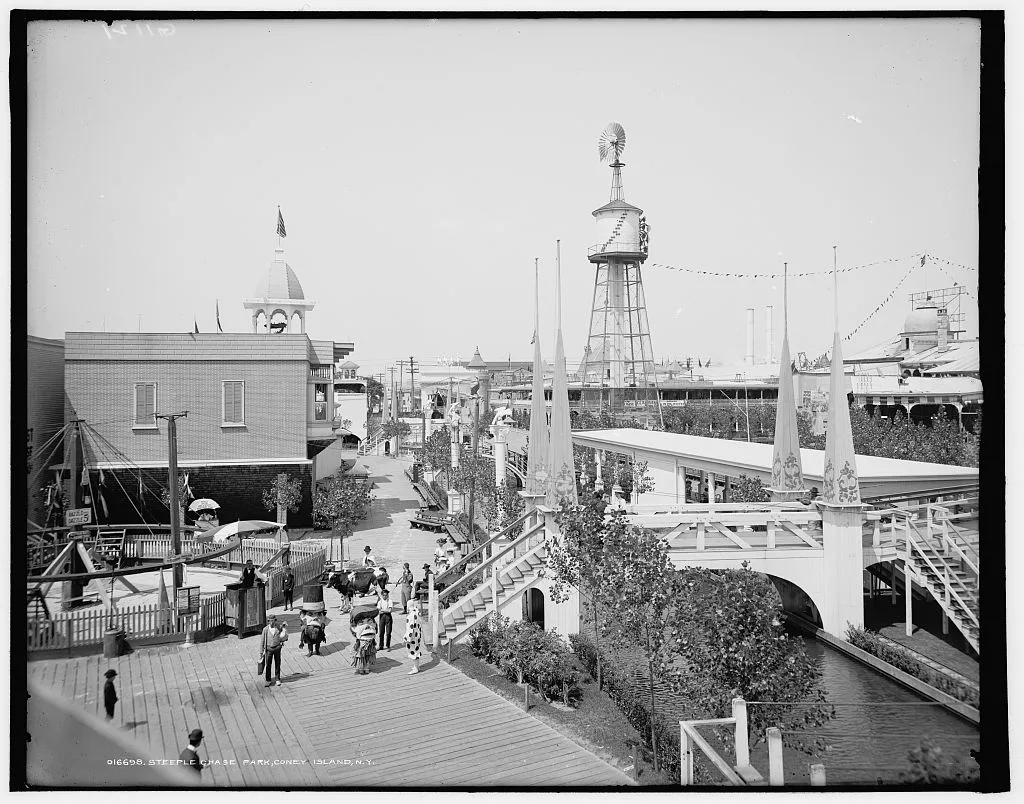
The signature ride was the Steeplechase Race. According to NYC Parks, riders raced gravity-powered wooden horses around a steel track. The mascot was a grinning “Funny Face” with several dozen teeth, nicknamed “the Tilly.”
In 1907 a fire destroyed 35 acres, NYC Parks says. The morning after, Tilyou posted a sign that ended: “Admission to the burning ruins: Ten cents.” Few owners have turned a total loss into a ticket line so fast. He rebuilt around the Pavilion of Fun, a glass-and-steel enclosure.
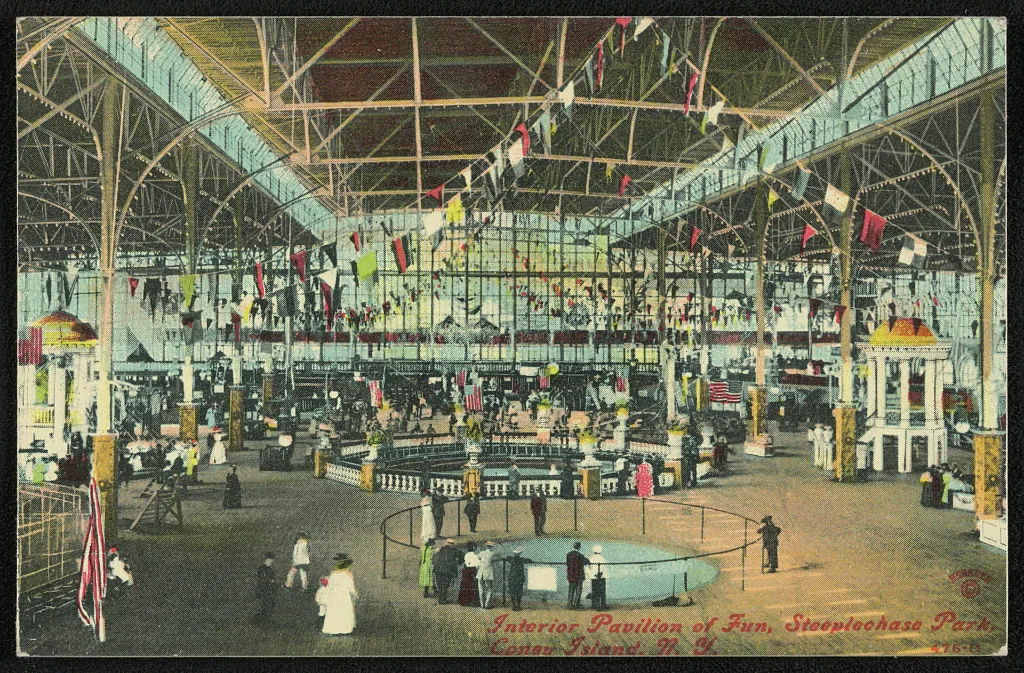
NYC Parks estimates that Steeplechase drew up to 90,000 people on a hot summer day in its peak years. Anyone who has waited in a long summer line can picture what a crowd that size does to a park. Of the three big Coney Island parks, Steeplechase lasted longest.
Luna Park and Dreamland
Luna Park opened on May 16, 1903. Its founders were Frederic Thompson and Elmer “Skip” Dundy, who had built the “A Trip to the Moon” ride. Admission was ten cents. On July 4, 1903, the park recorded 142,000 guests.
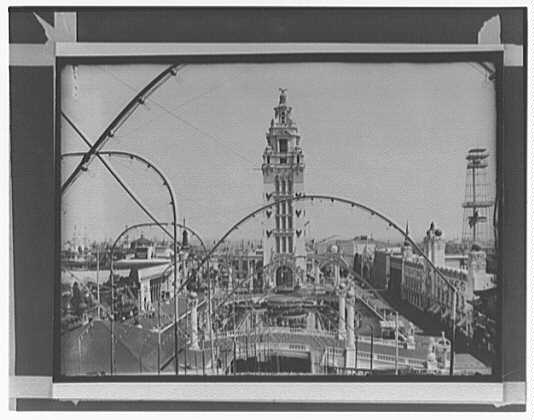
Dreamland followed in 1904. It was built by William H. Reynolds, and it burned in 1911. The photo below shows Dreamland Tower from the chutes in 1905. Seven years was all Dreamland got.
Coney Island Boardwalk History
NYC Parks says the boardwalk, which it calls “Coney Island’s Fifth Avenue,” opened with great fanfare on May 15, 1923. It is 80 feet wide and runs 2.7 miles. According to NYC Parks, “there are 1.3 million boards.”
It is named for Edward Riegelmann, who was Brooklyn Borough President from 1918 to 1924 and led its construction. Riegelmann said poor people would “no longer have to stand with their faces pressed against wire fences looking at the ocean.” In 2018 the city’s Landmarks Preservation Commission made the boardwalk a scenic landmark. That quote explains the boardwalk better than the measurements do.
Coney Island Cyclone History
The American Coaster Enthusiasts note that the Cyclone opened on June 26, 1927. It has 2,640 feet of track and stands about 85 feet high. Vernon Keenan designed it, Harry C. Baker built it, and it was made for the businessmen Jack and Irving Rosenthal.
The first drop is angled at 58.1 degrees, and the top speed is about 60 mph. A ride cost 25 cents on opening day, or 35 cents on Sundays and holidays. The ride became a New York City landmark in 1988 and was added to the National Register of Historic Places in 1991. Charles Lindbergh later described the Cyclone as more thrilling than flying. Few rides get a review like that from the man who flew the Atlantic alone.
Wonder Wheel History
Deno’s Wonder Wheel Amusement Park, which runs the wheel, says Charles Hermann invented it and the Eccentric Ferris Wheel Company built it. It opened on Memorial Day in 1920 under the name “Dip-the-Dip.” The wheel stands 150 feet tall and weighs about 200 tons.
It has 24 cars. Sixteen swing and eight stay fixed, and each holds up to six riders, so 144 people can ride at once. Its busiest day on record was July 4, 1947, with 14,506 riders. Deno Vourderis bought it on June 7, 1983, and it became a New York City landmark in 1989. More than a century on, it still turns.
Parachute Jump History
NYC Parks says the Parachute Jump was erected in 1939 for the New York World’s Fair in Flushing Meadows. It moved to Steeplechase Park in 1941. Navy Commander James H. Strong designed it. NYC Parks lists the steel tower at 262 feet and 170 tons, though that height included a flagpole at the fair. Today the tower is about 250 feet.
Adults paid 40 cents and children paid a quarter. The ride drew as many as half a million riders a year, NYC Parks says. It stopped running in the 1960s. The tower was listed on the National Register of Historic Places in 1980 and became a New York City landmark in 1989. Not bad for steel built to stand through two seasons of a fair.
When Did Coney Island Decline?
The decline came in steps. A fire on August 13, 1944 destroyed much of Luna Park, and it never reopened. Steeplechase closed for good after the 1964 season, on September 20, 1964. In 1965 the Tilyou family sold it to the developer Fred Trump, NYC Parks says. He demolished the Pavilion of Fun in a highly publicized ceremony in September 1966.
For what the city looked like a few years after that, see our photos of New York City in the 1970s. Most of us have seen a favorite old place replaced by something newer. At Coney Island, the Steeplechase site is now Maimonides Park, a minor-league ballpark that opened in 2001 as KeySpan Park. NYC Parks says the plan approved in 2000 called for a 6,500-seat stadium roughly on the old Pavilion of Fun site.
Revival came in smaller forms. Since 1983 the boardwalk has hosted the annual Mermaid Parade, according to NYC Parks. The Cyclone, the Wonder Wheel and the Parachute Jump are all landmarks today. The big parks did not survive, but the district did.
Vintage Coney Island FAQ
When did Coney Island’s boardwalk open?
NYC Parks says the boardwalk opened with great fanfare on May 15, 1923. It is 80 feet wide and runs 2.7 miles. It is named for Brooklyn Borough President Edward Riegelmann, who led its construction.
When did the Coney Island Cyclone open?
The American Coaster Enthusiasts say the Cyclone opened on June 26, 1927. It has 2,640 feet of track. It became a New York City landmark in 1988 and was listed on the National Register of Historic Places in 1991.
When did Steeplechase Park close?
Steeplechase closed for good on September 20, 1964, at the end of that season. The Tilyou family sold it in 1965 to developer Fred Trump. The Pavilion of Fun was demolished in a publicized ceremony in September 1966.
How tall is the Wonder Wheel?
Deno’s Wonder Wheel Amusement Park says the wheel is 150 feet tall and weighs about 200 tons. It has 24 cars, 16 swinging and 8 stationary, and can carry 144 riders at once.