

A crowded sidewalk beats a Christmas tree. Of all the vintage Christmas photos I have gone through, the one I would keep ahead of the rest is a 1910 news picture of shoppers on Sixth Avenue in New York, and there is no tree anywhere in it. The seven photographs here all come from the Library of Congress and run from 1910 to 1941. I have put them in order by one question: how much is left to look at once you take Christmas out of the frame.
That question comes from a habit of mine. I look at the background of an old photograph before I look at the people, because the cars at the curb and the lettering on the storefronts give away the year faster than any face will. A decorated tree defeats the habit, since a tree hung with glass balls in 1919 looks a good deal like one hung with glass balls in 1959. A street in December does the opposite. It keeps the prices, the signs and the traffic of one particular winter, and it has Christmas in it as well.
The tree picture is here too, sixth of seven, because it is the kind most of us actually own and it deserves a fair hearing. So does the seventh, which has no decoration in it at all and is the hardest of the lot to place.
Sixth Avenue in 1910 gives you a whole street to read
The picture at the top of this page was made for the newspapers by the Bain News Service, and its caption, “6th Ave., Xmas shoppers,” is lettered by hand across the top of the glass negative. The camera looks down from a height on a sidewalk so full that the crowd spills off the curb. The women wear hats as wide as their shoulders. The men are nearly all in derbies, and nobody thinks to look up.
Now take the holiday away and see what remains. There is a corner sign for 17th Street, a trunk and bag shop that says it was established in 1845, and a board offering suits, waists, skirts and furs. An upstairs window advertises beauty parlors, a chiropodist and human hair goods. A street clock hangs under the name of a suit house. A wagon stacked with rolled goods pushes through behind a team of horses while a single motor car waits at the curb. The ironwork of the elevated railway runs down the right-hand edge. One frame holds the shops, the transport and the dress of a single December day, which is more than most whole albums manage.
Christmas is in it, but you have to hunt for it, and I enjoy the hunt. Near the lamppost at the bottom of the frame stands a figure in a long belted coat with a white beard, who looks to me very much like a sidewalk Santa working the crowd. I cannot prove it from the record, which gives only the title and the year. I am keeping him anyway.
A Rhode Island gas station sold trees beside the pumps
Jack Delano’s December 1940 photograph of Christmas trees for sale at a gas station in Woonsocket, Rhode Island, comes second, and it earns the place without a single person in the frame. Cut trees lean in rows against a corner building, and a sandwich board reads “Xmas Trees, Free Delivery.” Two pumps stand in front of them like sentries. Sixth Avenue wins on sheer quantity, yet this picture is easier to read, because Delano stood at street level and his negative is far sharper than a news plate of thirty years earlier.
Cover the trees and the year is still written all over it. The price board on the pump breaks a gallon into 9.6 cents for the gasoline and 4.5 cents of tax, 14.1 cents in all. A sign overhead tells drivers to “Winterize Now,” with a cartoon mouse in a cap to press the point, and the windows promise batteries, tires and easy terms. Getting the car ready before the first hard cold is still a ritual where I live in the Midwest, and I am late with it most years, so that sign left me feeling both at home and faintly scolded.
The best thing about it is how little ceremony there is. Somebody with a paved lot and a slow week sold trees between oil changes and offered to bring them to your door. Plenty of roadside attractions have less to read on them than this one corner. A tree lot is also the nearest a street scene comes to the living-room picture. It is the better of the two, because the tree has not yet been carried out of the world it was sold in.
Inside a Washington five-and-ten in December 1941
Third place goes indoors, which is a step down by the measure used here, since a store counter shows less of the world than a street corner does. John Collier photographed Christmas shopping in a Woolworth’s five and ten cent store in Washington, D.C., and this frame looks across a counter heaped with rolls of wrapping paper. The cards above them read “Package 10¢.” Stacks of paper cups and plates climb the shelves behind. A soldier with a sergeant’s stripes on his overcoat sleeve reaches for a roll, and women in hats wait their turn at his shoulder.
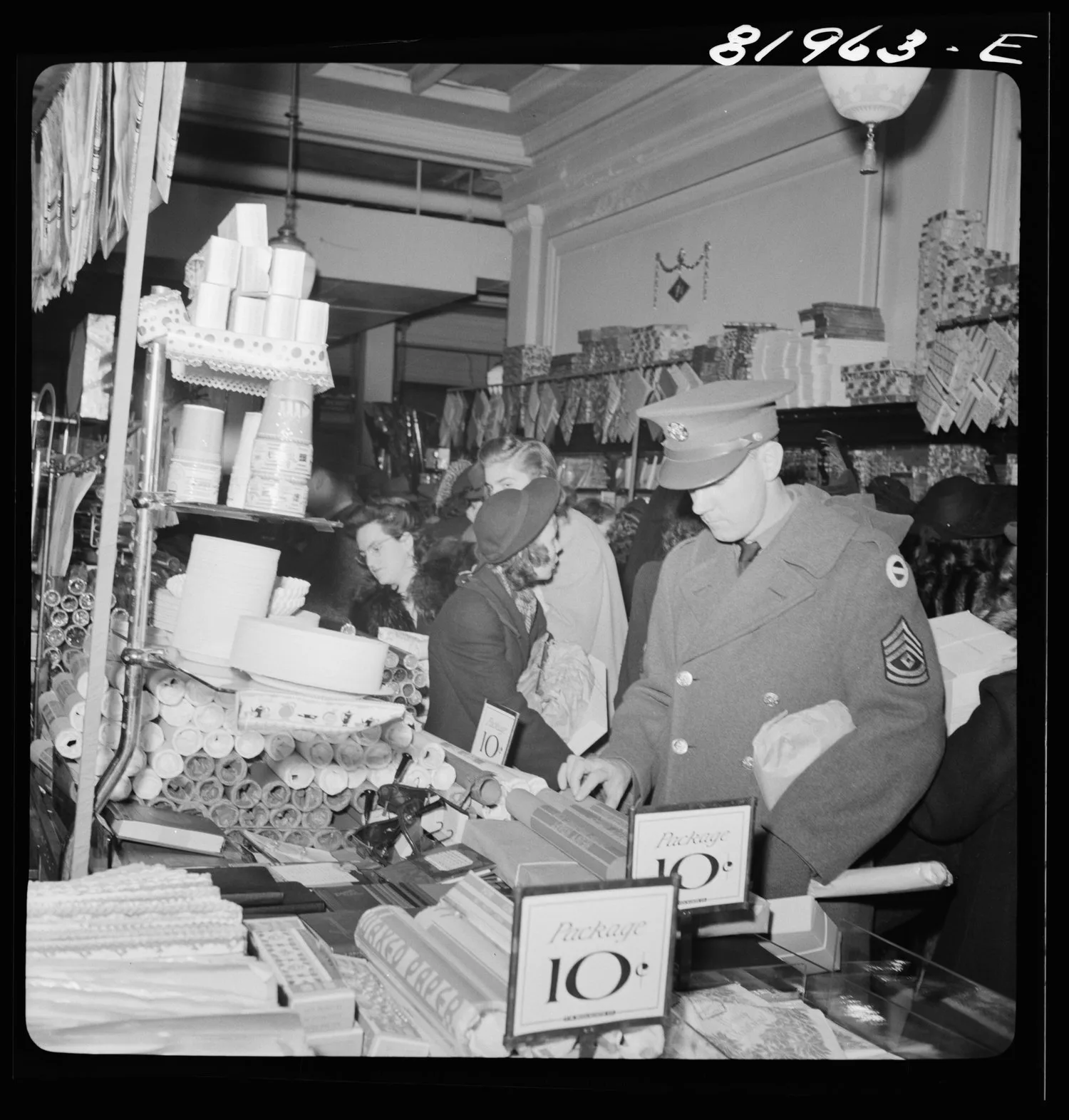
Here the date does the work that the background did on Sixth Avenue. The record says only December 1941, so there is no telling whether this was the week before Pearl Harbor or one of the weeks after it. Either way, a man in uniform choosing ten-cent wrapping paper tells you something about that month that no tree could. Collier made a whole run of frames in the same store under the same title, and they reward going through in order. It ranks below the gas station only because the counter fills the frame so completely that the city outside disappears.
Three boys at a toy window, and a record with no date
This is the picture people expect to see first, and it is easy to see why. Three boys in caps and heavy wool coats stand at a shop window, half turned away from us. Inside is a sleigh drawn by model reindeer and loaded with stuffed animals, and below it a doll in a white dress, a pair of teddy bears and a toy drum. A man at the edge of the frame holds a wrapped parcel under his arm and looks in over their heads. It has more feeling in it than anything ranked above it.
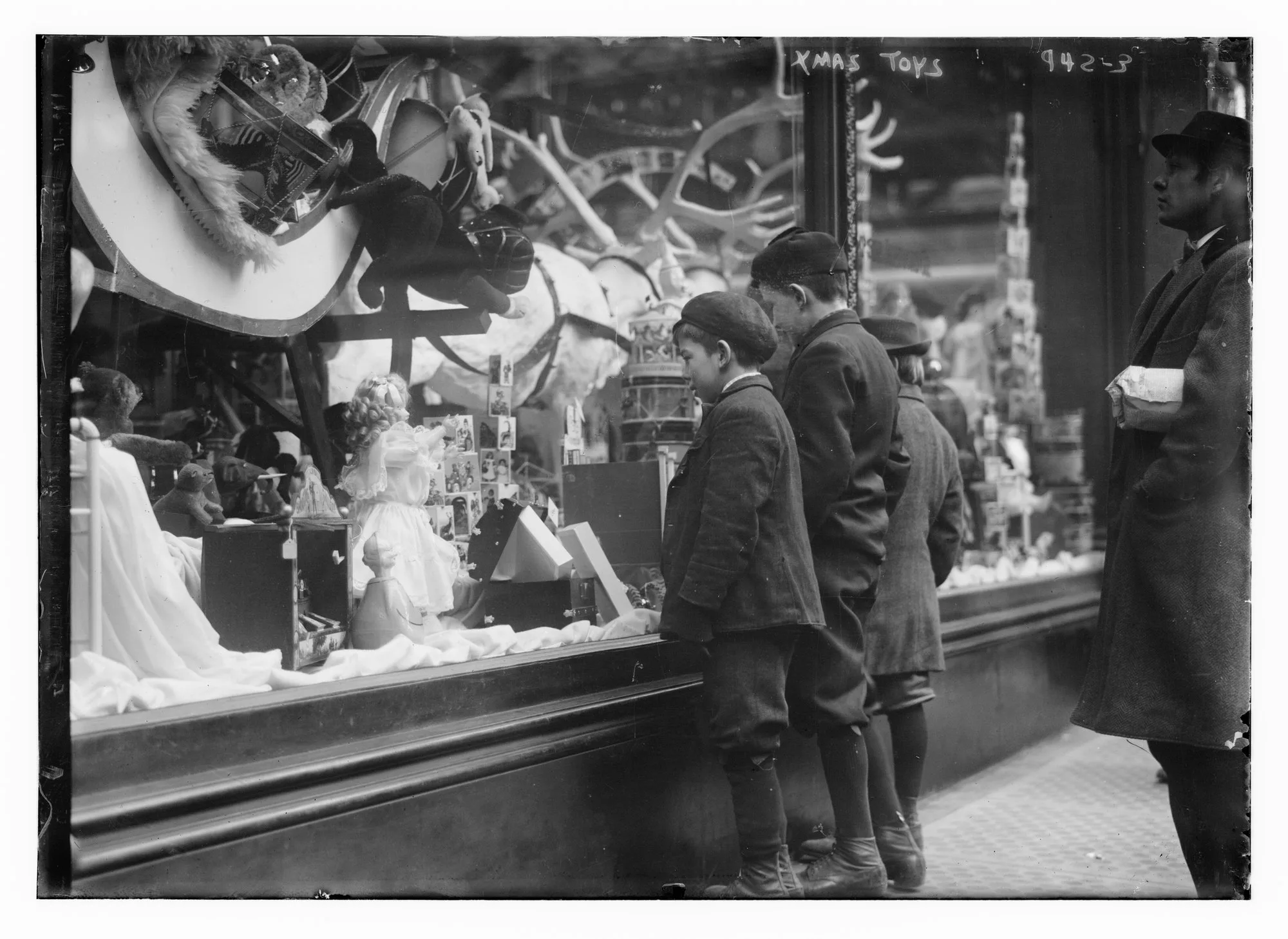
It also shows how far feeling will take you, which is not quite far enough. The record for “Children looking at Xmas toys in shop window” carries no date at all, and the frame cannot supply one, because the photographer stood so close that the street has gone. Most of the Bain pictures date from the 1900s to the mid-1920s, and the knee pants and flat caps fit that range, but that is as far as the evidence goes. Bain’s photographers worked New York harder than anywhere else, the city of Sixth Avenue and of Coney Island in its great years, so a New York shop window is a fair guess and still a guess. Sixth Avenue came with a cross street. This one comes with three boys and a wish, and although that is a great deal, it is why the picture sits fourth.
One truck and the first Christmas of parcel post
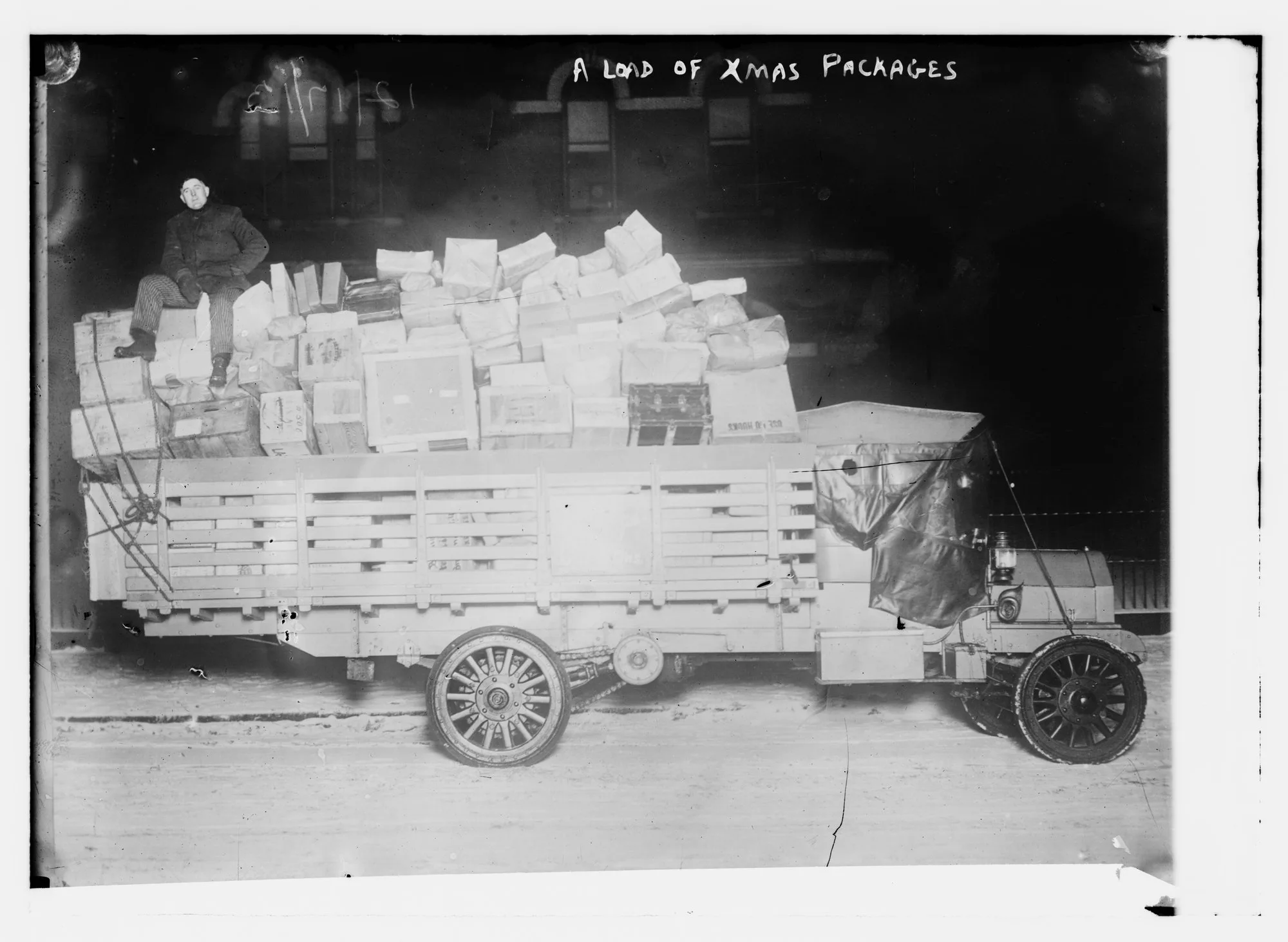
The fifth picture is a single joke told well. An open motor truck is stacked far above its side rails with boxes and bundles, and a man sits on top of the heap with his legs dangling. The words “A load of Xmas packages” are written across the negative beside the date, December 17, 1913. There is snow on the pavement and a dark building behind, and that is all there is to see. What lifts it is the calendar, because parcel post began on January 1, 1913, which made this the first Christmas with it. The record does not say whose truck this is, and nothing proves it belonged to the Post Office. It does show what a week before Christmas looked like in the first year a nation could mail its presents.
The family in front of the tree, and the dinner with no tree at all
Here is the tree at last. About 1919, the National Photo Company of Washington, D.C., sat a family down on the floor in front of their Christmas tree: the father with the youngest on his knee, the mother in a pale dress, a boy who has shut his eyes, a girl holding a doll. An older son kneels at the edge. The tree is wider than it is tall and crowded with glass ornaments and ropes of beads, and its top runs out of the picture. In front of them all sits a toy battleship nearly as long as the boy.
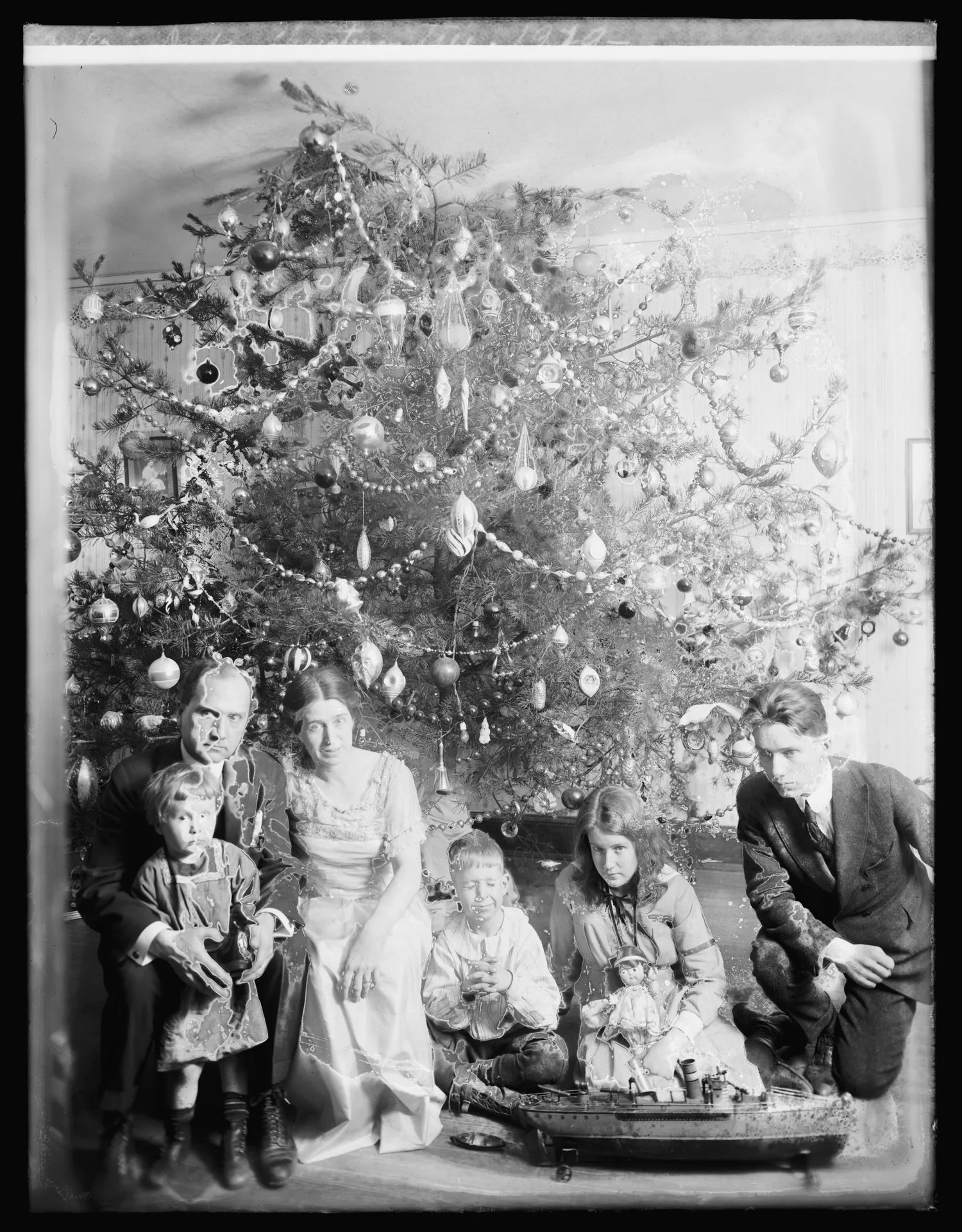
By the measure I have used all the way down, this is the weakest of the seven, because once the tree is covered you are left with striped wallpaper and six faces. It is also the reason I usually leave an antique mall empty-handed. I cannot pass a box of old snapshots without going through every one, and most of the Christmas pictures in those boxes are a tree and a row of strangers, with nothing behind them to say where or when.
Still, the picture has earned two concessions. The battleship dates the room better than a toy has any right to, within a year or two of the end of the First World War. And the same company photographed this family at its tree again and again, with four of the pictures dated 1913, 1915, 1918 and 1923. A run like that shows something a street scene cannot, because the parents age and the children grow while the pose stays exactly where it was. A single tree portrait gives you one evening. Ten years of them give you a family growing up, so if you own such a run, keep every frame of it together.
Then there is the photograph that upsets the whole order. Russell Lee took it in December 1936 in a tenant farmer’s home near Smithland, Iowa, and the caption card says that Christmas dinner “consisted of potatoes, cabbage and pie.” Four small children stand around a rough table, the smallest on a low bench to reach the plates. A hand-cranked cream separator fills the left side of the room, and a flattened packing-house carton is nailed over the boards of the wall. A cat waits in the shadow underneath. Lee worked for the same federal project whose photographers made the family Thanksgiving tables of 1940 and 1942, and those tables were full.
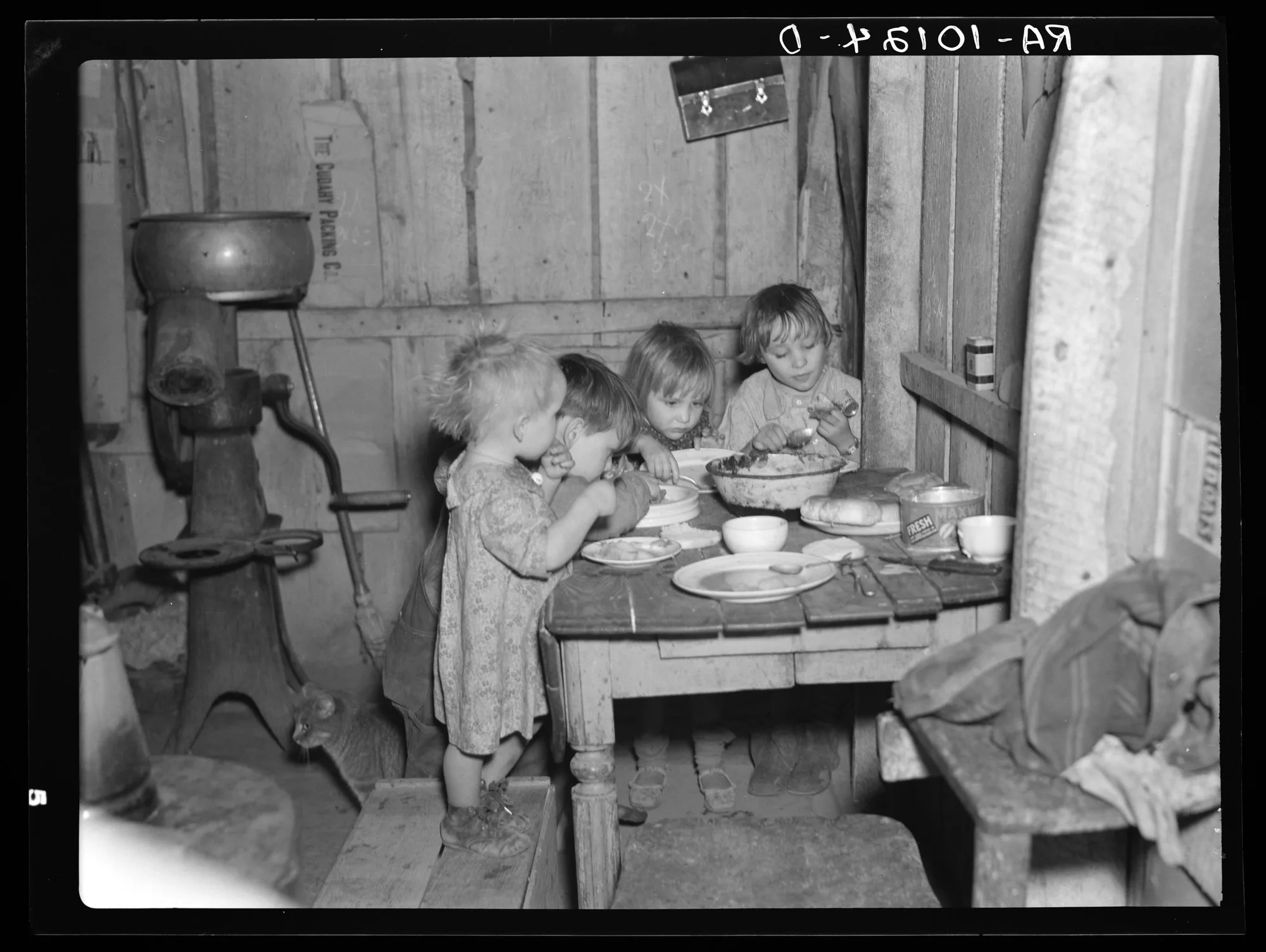
There is no tree here, no wreath and no gift, and nothing in the frame says December 25 except the words on the card. When I first sorted these seven I put it last for that reason, since I thought a Christmas photograph ought to show some Christmas. I was wrong, or at least I was running my own rule backwards. If the measure is how much remains once the holiday is removed, this picture is all remainder, and it is the best photograph on the page by some distance.
I have left it at the end all the same, for two reasons. It belongs beside the family portrait, because the two rooms are about seventeen years apart and each explains the other. And Sixth Avenue is still the one I would keep as a Christmas photograph, because it holds the holiday and the world in a single frame, while Lee’s holds only the world. You may weigh those the other way, and I would not argue for long.
Where to find old Christmas photos you can use for free
All seven came from the Library of Congress online catalog, and each record carries a rights line that begins “No known restrictions.” Read that line on every record before you print or post a picture, because the Library does not own the rights to what it holds and leaves the checking to you. Each record offers a small JPEG and a large TIFF file, and the TIFF is the one to download for printing. The Sixth Avenue file is more than 5,700 pixels wide, which at 300 dots per inch is enough for a sharp print about 19 inches across.
The order above doubles as a way to search. The street scenes come from two collections, the Bain news photographs and the federal photo project that ran from 1935 to 1944. That project left about 175,000 black-and-white negatives, so look inside those two first. Type “Xmas” as well as “Christmas,” because the Bain captions were lettered in a hurry and three of the seven here carry only the short form in their titles. Then add a place to the holiday, such as a store name, a street or the word “shoppers,” since that is how you reach the sidewalk and get past the studio.
One limit should be said plainly. The three collections used here all stop by 1944, so the Christmas of the 1950s and 1960s, with its aluminum trees and color slides, is not in them. For those years the best archive is still the shoebox in a relative’s closet, and the same habit applies there: pull out the pictures where somebody left the car, the kitchen or the front porch in the frame. The table below has what you need to look up each of the seven.
| Photo | Date on the record | Place | Photographer or company |
|---|---|---|---|
| Sixth Avenue shoppers | 1910 | New York | Bain News Service |
| Trees at a gas station | December 1940 | Woonsocket, Rhode Island | Jack Delano |
| Woolworth’s counter | December 1941 | Washington, D.C. | John Collier |
| Boys at a toy window | Not recorded | Not recorded | Bain News Service |
| Truck of packages | December 17, 1913 | Not recorded | Bain News Service |
| Family and tree | 1919 or 1920 | Not recorded | National Photo Company |
| Farm Christmas dinner | December 1936 | Near Smithland, Iowa | Russell Lee |