

While a spirit-spotting tour of North America’s grandest historic hostelries may strike the uninitiated as a whimsical pursuit—or at best, a glamorous excuse to pay top dollar for squeaky floorboards—the serious enthusiast knows that a night spent courting the supernatural demands a rigorous appreciation for early twentieth-century architecture, precise room numbers, and the undeniable charm of a well-documented spectral apparition.
Beneath the thick layer of cinematic exaggeration and theatrical ghost walks, certain legendary hotels offer an intoxicating confluence of verifiable history, architectural splendor, and remarkably persistent parapsychology. Searching for the most genuinely intriguing haunted hotels across the continent requires looking past the cheap jump-scares to find properties where rich detail and unexplained phenomena meet seamlessly. What follows is a carefully curated field guide to the most historically substantial and haunted hotels open to discerning travelers today; places where the past doesn’t merely linger in dusty accoutrement, but actively checks into the suite next door.
1. The Stanley Hotel: High-Altitude Grandeur and Orchestral Echoes
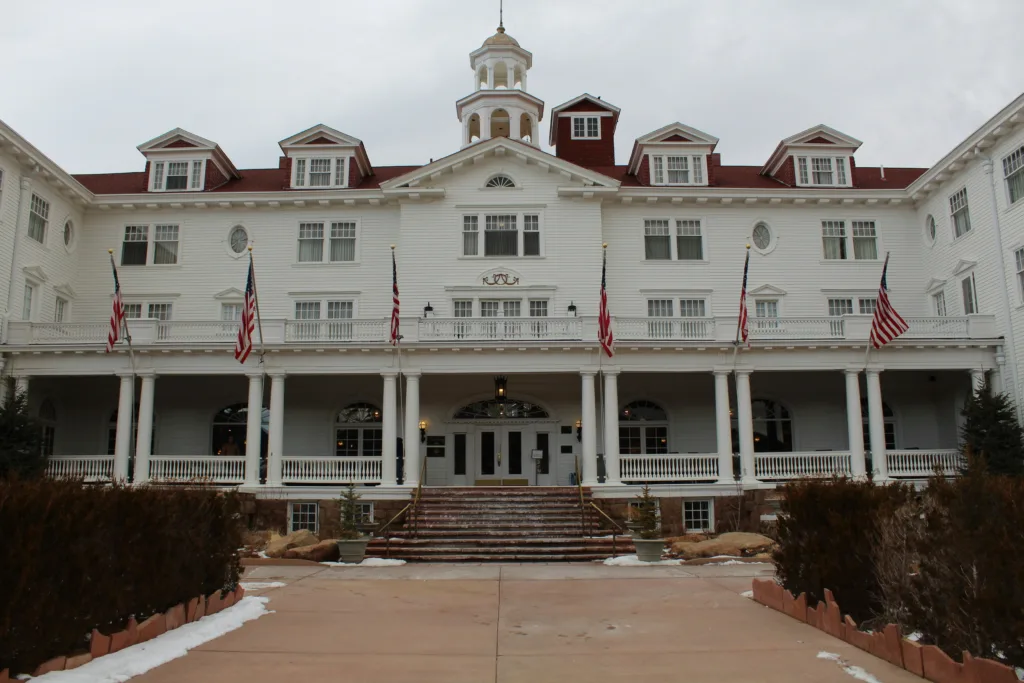
Perched at 7,500 feet above sea level in Estes Park, Colorado, the 1909 Georgian Revival masterpiece constructed by Freelan Oscar Stanley—inventor of the Stanley Steamer automobile—remains the undisputed North American mecca for connoisseurs of high-altitude spectral phenomena. While casual pop-culture aficionados compulsively associate the property with Stephen King’s snowy night in Room 217—a fateful stay in 1974 that birthed The Shining—seasoned lodge-goers know that the hotel’s true paranormal pedigree rests in its flawless architectural acoustics and the unyielding devotion of its founders.
The sprawling 140-room timber-and-plaster structure, engineered meticulously to act as a mountain refuge for upper-crust tuberculosis sufferers, functions almost like a giant wooden soundboard, amplifying midnight reverberations through its mahogany-paneled corridors. Guests staying in the Fourth Floor rooms—originally constructed as unheated quarters for children, nannies, and domestic staff—frequently record the distinct, rhythmic pitter-patter of unseen leather-soled shoes, while down in the main Concert Hall, the lingering residue of Flora Stanley’s Steinway piano playing still drifts across the empty floorboards long after midnight (a phenomenon that house engineers routinely fail to attribute to HVAC vibrations). Among the vast registry of haunted hotels dotting the American West, few can match the sheer documentation compiled here, making a night in the original main building a Masterclass in historic architectural resonance.
2. 1886 Crescent Hotel & Spa: The Mountaintop Ozark Sanatorium
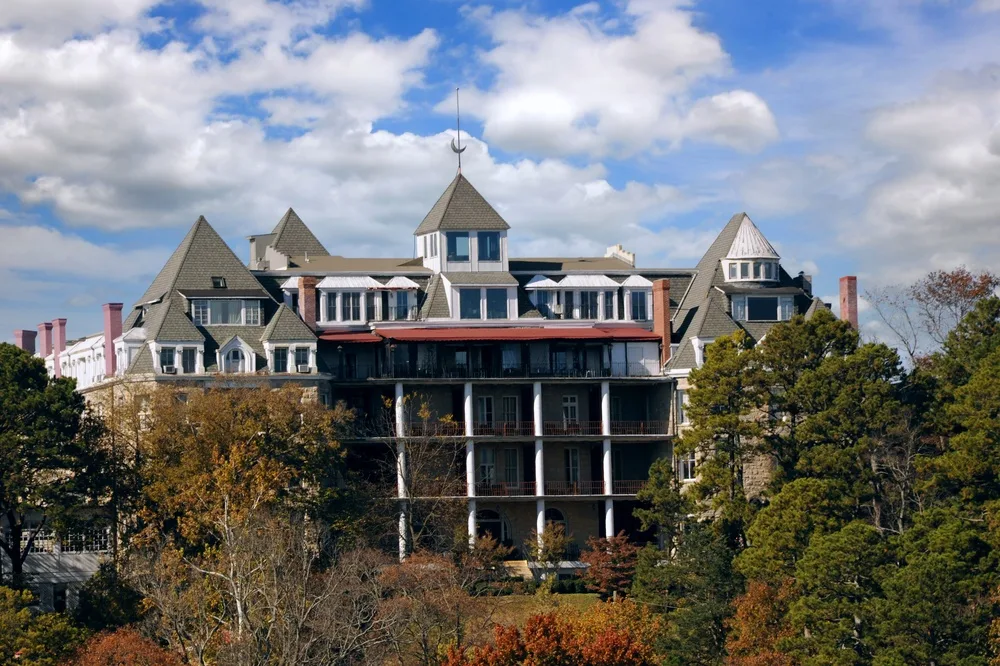
Deep in the Ozark Mountains of Eureka Springs, Arkansas, the Crescent Hotel stands as a towering limestone monolith that has served sequentially as a Gilded Age luxury resort, a conservative women’s conservatory, and most notoriously, Norman Baker’s fraudulent “cancer curing” hospital in the late 1930s. Built from locally quarried white dolomite stone, the 1886 structure carries a palpable historical gravitas that hits visitors long before they step off the birdcage elevator.
The hotel’s documentation logs are extraordinarily specific, pinpointing Room 218 as the epicenter for Michael, an Irish stonemason who tragically fell to his death during the 1885 construction and now expresses his lingering presence through flickering lamps and heavy bathroom door movements. Meanwhile, down in the morgue-turned-spa basement where Baker once kept his infamous sample jars, cold spots drop precipitously by fifteen degrees without environmental cause, ensuring that any tour of this Ozark bastion remains saturated in macabre authenticity. For those evaluating the historical credibility of haunted hotels, the Crescent’s preserved medical artifacts, subterranean morgue, and precise incident record books provide an empirical backbone that few other historic inns can hope to replicate.
3. Hotel Monteleone: French Quarter Elegance and Clockwork Curiosities
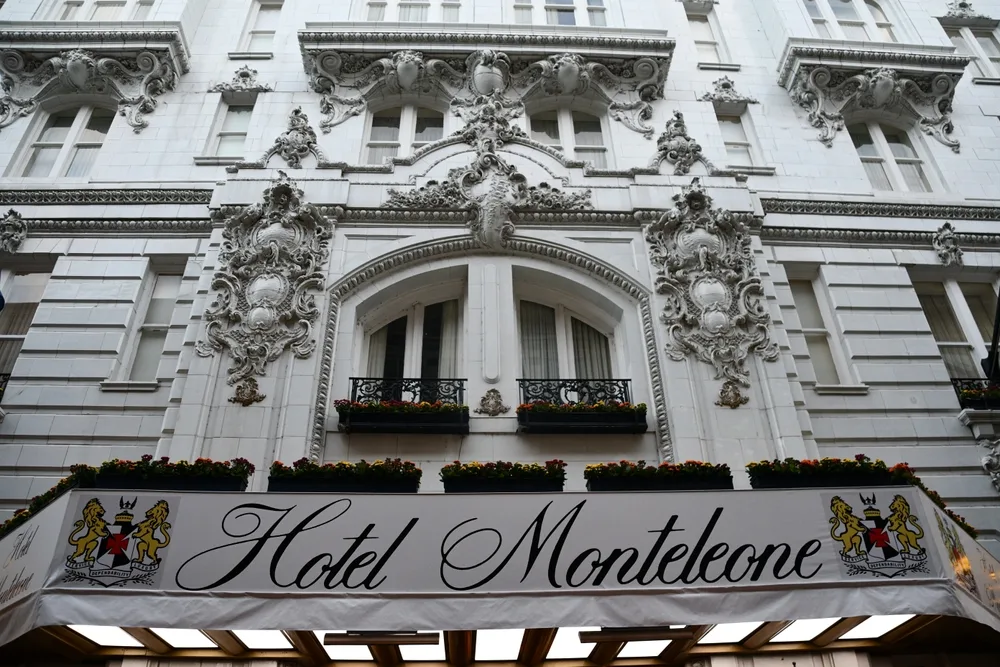
Rising imperially above Royal Street in New Orleans, Louisiana, the Hotel Monteleone represents one of the few remaining family-owned grand hotels in the United States. Established in 1886 by Sicilian nobleman Antonio Monteleone, the hotel’s opulent interior, adorned with crystal chandeliers, hand-carved Italian marble, and custom grandfather clocks; houses a remarkably well-cataloged contingent of historic spirits.
The fourteenth floor is particularly renowned for the apparition of Maurice Begere, a young boy from the late nineteenth century who frequently manifests near Room 1414 looking for his parents, leaving room doors unlocked and temperature gauges plummeting in his wake. Equally compelling are the repeated archival sightings of a former maintenance worker named “Red,” who continually attempts to regulate the hotel’s original mechanical systems, along with an antique brass clock in the lobby that routinely chimes on the half-hour despite missing crucial internal gears Among urban haunted hotels, the Monteleone shines as a masterwork of Southern Gothic sophistication, where supernatural encounters are delivered with service and a musician’s sprinkle of jazz history.
4. The Marshall House: Savannah’s Antebellum Infirmary
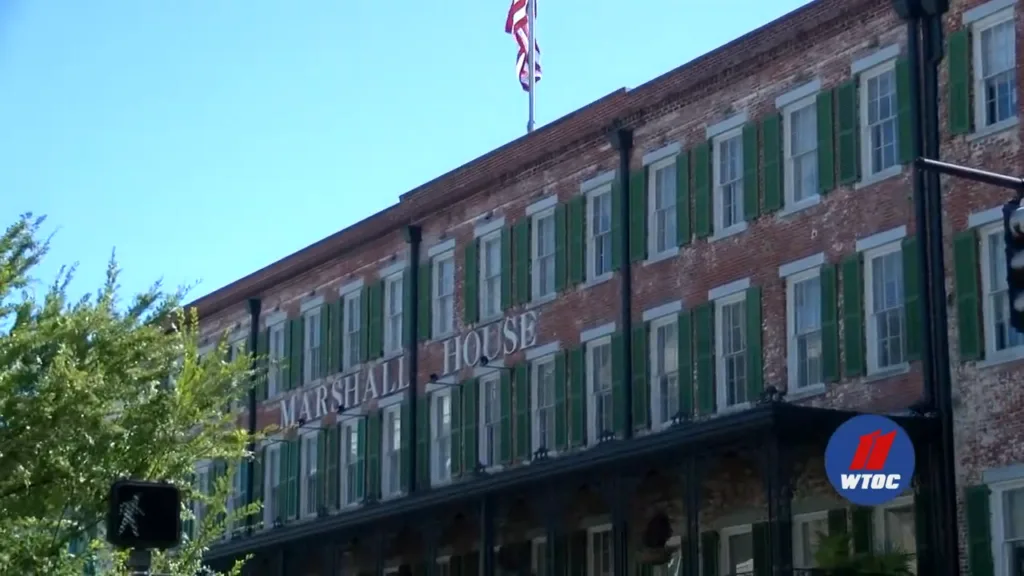
Located on Broughton Street in Savannah, Georgia, The Marshall House is a quintessential antebellum sanctuary that spent much of the nineteenth century operating as a military field hospital during both the Yellow Fever epidemics and the American Civil War. During late-twentieth-century renovations, contractor crews uncovering original floorboards beneath the first-floor boarding rooms made the chilling discovery of nineteenth-century surgical amputations buried beneath the joists, instantly solidifying the property’s reputation among academic historians and ghost hunters alike.
Walking down the third-floor corridors, guests routinely report seeing Union soldiers in uniform carrying oil lamps, accompanied by the distinct smell of burning kerosene and floorboard footsteps that stop abruptly at closed doors. The hotel’s long, airy balconies offer a stunning view of historic Savannah, but the true draw remains its internal atmosphere, where pediatric ghosts reportedly play marble games along the runners of the second-floor hallway in the dead of night. When indexing authentic haunted hotels across the American South, The Marshall House stands out precisely because its ghostly lore is backed by physical archaeological discoveries.
Field Notes for the Discerning Ghost Hunter
To maximize both your historical appreciation and your likelihood of recording unexplained phenomena during your stays, keep the following tactical recommendations in mind:
- Target Off-Peak Midweek Stays: High weekend occupancy introduces acoustic pollution—running water, door slams, and footsteps from adjacent rooms—that muddies your observational baseline; late Tuesday night is your best friend.
- Request Historic Core Rooms: Modern extensions and annexed wings rarely carry the architectural materials or archival history needed for genuine encounters; always request rooms within the original pre-1920 structural footprint.
- Document Baseline Room Temperatures: Carry a basic digital thermal scanner to distinguish simple, drafty single-pane window leaks from genuine localized temperature drops that defy environmental explanations.