

Here are ten places to honor the fallen on Memorial Day. They include Arlington National Cemetery, the Punchbowl in Honolulu, the USS Arizona Memorial and the Normandy American Cemetery, plus six more. Each one comes with the dates and numbers its caretakers publish.
Updated October 26, 2026.
Memorial Day falls on the last Monday of May. For lots of Americans that means a long weekend, a barbecue and a day off. Most of us have spent that weekend with a grill going and a cooler full of drinks, and it is easy to forget why we have the day. It is a day to enjoy the freedom so many have fought for, and to remember what it cost. One good way to do that is to visit some of the Memorial Day monuments around the country.
It began as Decoration Day. On May 5, 1868, Maj. Gen. John A. Logan issued General Orders No. 11. He led the Grand Army of the Republic, a group of Union veterans. The order set aside May 30 as a day to decorate the graves of Civil War dead. The first big ceremony was held at Arlington National Cemetery that day. Waterloo, New York, says it held an earlier one on May 5, 1866. In 1966 Congress recognized the town as the birthplace of Memorial Day, according to the National Archives.
After World War I, the day grew to honor Americans who died in every war. A law signed on June 28, 1968, made it a national holiday. It took effect on January 1, 1971, and put the day on the last Monday in May.
All across America there are parades for the people who gave their lives serving their country. Many feature active military members and veterans. You will see people wearing red poppies to remember the fallen. Some will visit cemeteries and memorials. Anyone who has stood on a curb as a veterans’ parade went by knows how quiet a whole crowd can get when the flags pass.
My father served in the military for well over 20 years. He fought in three wars: World War II, the Korean War and the Vietnam War. He always made a big deal of Memorial Day when I was growing up. He talked about the friends he had lost. He told us why it matters to remember them and the price they paid so the rest of us could enjoy our freedom.
Memorial Day monuments: how to choose where to go
On this Memorial Day, take time to honor, cherish and remember our fallen heroes. Say a prayer, wear a red poppy, go to a parade, or visit a national cemetery or memorial. The list below is a good place to start. For cemeteries that are not on it, visit the National Cemetery Administration. For war memorials, the American Battle Monuments Commission keeps a long list.
Arlington National Cemetery

Just across the Potomac from Washington, DC, Arlington covers 639 acres and holds nearly 430,000 veterans and their eligible family members. It is perhaps the most significant national cemetery in the country. Presidents, astronauts and other national heroes rest here. It takes in fallen soldiers from every war. John F. Kennedy was buried here on November 25, 1963.
The cemetery is also home to the Tomb of the Unknown Soldier. An unknown soldier from World War I was laid to rest there on November 11, 1921, and unknowns from World War II and Korea followed in 1958. A Vietnam unknown was buried on Memorial Day, May 28, 1984. But DNA testing identified him in 1998 as Air Force 1st Lt. Michael Joseph Blassie. His family reburied him in Missouri. That crypt is empty now and honors all the U.S. service members still missing from Vietnam. The Old Guard has guarded the Tomb since April 6, 1948.

Next door, in Arlington Ridge Park, stands the Marine Corps War Memorial, also called the Iwo Jima Memorial. Sculptor Felix de Weldon based it on Joe Rosenthal’s photograph of six men raising the flag on Mount Suribachi on February 23, 1945. That was the second flag raising that day. It was dedicated on November 10, 1954 to the Marines who died in all wars.

Arlington National Cemetery, Arlington, VA 22211
National Memorial Cemetery of the Pacific

People call it the Punchbowl because it sits in a crater. The cemetery opened to the public on July 19, 1949. Its Hawaiian name, Puowaina, is most often translated as ‘Hill of Sacrifice.’ It honors those who died in the Pacific in World War II. It also holds service members from the Korean and Vietnam wars. The Courts of the Missing carry more than 28,000 names from all three wars. The Pulitzer Prize-winning war correspondent Ernie Pyle is buried here.
National Memorial Cemetery of the Pacific, 2177 Puowaina Dr, Honolulu, HI 96813
USS Arizona Memorial

The USS Arizona Memorial is part of the Pearl Harbor National Memorial in Honolulu. Architect Alfred Preis designed it, and it was dedicated in 1962. It is a somber place. The memorial sits over the sunken ship, and you can only reach it by Navy shuttle boat. Every visitor needs a ticket through Recreation.gov, so book ahead. Anyone who has tried to get tickets to a popular place at the last minute knows why it pays to plan early. On December 7, 1941, 1,177 of the Arizona’s crew were killed. The National Park Service says more than 900 of them still rest in the wreck.

Pearl Harbor National Memorial, 1 Arizona Memorial Pl, Honolulu, HI 96818
Normandy American Cemetery and Memorial

June 6, 1944, was D-Day. The Allies invaded German-occupied France to start pushing back against Hitler in Europe. Omaha Beach was one of five landing sectors, and it was the American job. U.S. forces finally took the beach after a brutal fight, and it cost a great deal. The cemetery was set up on June 8, 1944, on a bluff above the beach. It sits a short distance east of the temporary cemetery from D-Day.
The American Battle Monuments Commission runs it. The permanent cemetery was dedicated on July 19, 1956. It covers 172.5 acres, holds 9,389 burials and lists 1,557 names on the Wall of the Missing. Three Medal of Honor recipients are buried here. Most of the people buried here died in the D-Day landings and the fighting that followed. France gave the United States use of the land for an unlimited time, free of charge and tax.

Normandy American Cemetery and Memorial, 14710 Colleville-sur-Mer, France
Vietnam Veterans Memorial Wall

The Vietnam War divided the country and, in some cases, families. It took time for America to heal and to see how brave the people who served and died really were. The Vietnam Veterans Memorial Wall was a big part of that healing. The National Park Service lists 58,318 Americans on the wall, in the order they died. The memorial has three parts. They are the Wall, the Three Servicemen statue, added soon after the memorial opened, and the Vietnam Women’s Memorial. That one was dedicated in 1993 to the more than 265,000 women who served in that era.


Vietnam Veterans Memorial Wall, 5 Henry Bacon Dr NW, Washington, DC 20245
The Korean War Veterans Memorial

The Korean War lasted only three years, yet the American Battle Monuments Commission counts 54,246 Americans who died between June 25, 1950 and July 27, 1953. Another 103,284 were wounded. The memorial was dedicated on July 27, 1995, 42 years to the day after the armistice. Nineteen stainless steel statues seem to walk across the site, and they reflect in a black granite wall. The National Park Service says that makes it look like 38 soldiers.

The Korean War Veterans Memorial, 900 Ohio Dr SW, Washington, DC 20024
Gettysburg National Cemetery

Gettysburg was the bloodiest battle of the Civil War. It raged for three days, July 1 to 3, 1863, in and around the Pennsylvania town. The American Battlefield Trust estimates 51,112 casualties on both sides. Many historians call it the turning point, since the Confederate army then retreated to Virginia. Less than five months later, on November 19, 1863, the cemetery was dedicated. Abraham Lincoln gave his Gettysburg Address that day. Almost everyone has heard its first line, even if it has been years since school. The cemetery holds 3,512 Civil War burials, 979 of them unknown, and more than 6,000 burials in all.

Gettysburg National Cemetery, 1195 Baltimore Pike, Gettysburg, PA 17325
San Francisco National Cemetery

The War Department set up this cemetery in the Presidio of San Francisco on December 12, 1884, on 9.5 acres. It has since grown to 28.34 acres. The Presidio began as a Spanish fort. The cemetery looks out over the Golden Gate Bridge and San Francisco Bay. The VA lists 40 Medal of Honor recipients buried or honored here. It is also home to Buffalo Soldiers, the African-American soldiers who served in the army after the Civil War. Monuments include the Pacific Coast Garrison Monument (1897) and one from 1900 to the Marines who died at the Tartar Wall in Beijing.
San Francisco National Cemetery, 1 Lincoln Blvd, San Francisco, CA 94129
West Point Cemetery

The cemetery sits on the grounds of the U.S. Military Academy and looks out over the Hudson River. It was a burial ground for Continental Army soldiers and early West Point residents long before it was formally made a military cemetery in 1817. West Point has produced some of the greatest military minds in American history. George Armstrong Custer is buried here. So is Gen. H. Norman Schwarzkopf, who commanded coalition forces in the Gulf War.
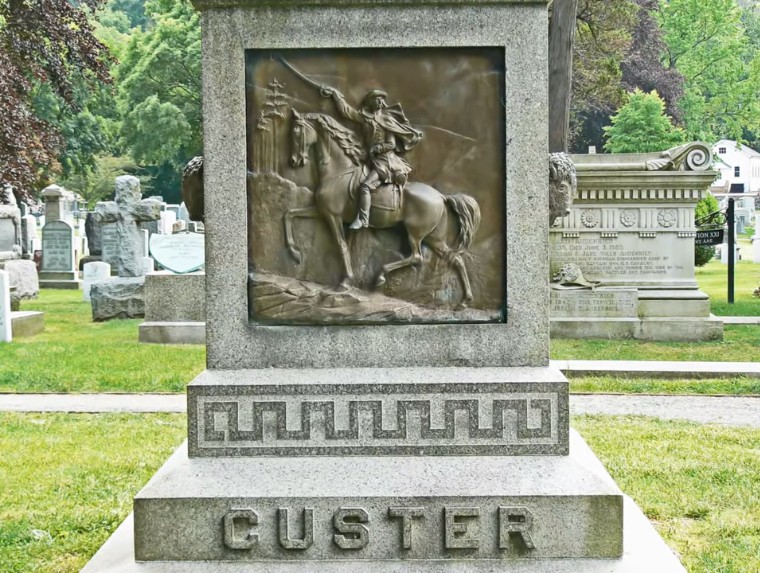
West Point Cemetery, 329 Washington Rd, West Point, NY 10996
The National World War II Memorial

Friedrich St. Florian designed this impressive memorial in Washington, DC. It opened to the public on April 29, 2004, and was dedicated on May 29, 2004. It honors the 16 million Americans who served, and it is open 24 hours a day. Its 56 granite pillars stand for the states, territories and the District of Columbia, and 24 bronze panels show wartime scenes at the front and at home. The Freedom Wall carries 4,048 gold stars. Each star stands for 100 Americans who died in the war.
The National World War II Memorial, 1750 Independence Ave SW, Washington, DC 20024
Memorial Day monuments: questions answered
Which Memorial Day monuments are in Washington, DC?
Three of the ten: the Vietnam Veterans Memorial, which lists 58,318 names, the Korean War Veterans Memorial, dedicated July 27, 1995, and the National World War II Memorial, dedicated May 29, 2004. Arlington National Cemetery is just across the Potomac River in Virginia.
Which Memorial Day monuments are outside the United States?
The Normandy American Cemetery at Colleville-sur-Mer, France, is the one on this list. The American Battle Monuments Commission runs it along with other overseas cemeteries and memorials, and its website lists them all if you are planning a longer trip.
Who is in the Tomb of the Unknown Soldier?
Unknown service members from World War I, World War II and the Korean War remain in the Tomb at Arlington. The Vietnam unknown was identified by DNA in 1998 as Air Force 1st Lt. Michael Joseph Blassie and reburied by his family, so that crypt is empty and honors all missing Vietnam service members.